As an Amazon Associate, we earn from qualifying purchases. Some links on this site are affiliate links at no extra cost to you. Our recommendations are based on thorough research and editorial judgment.


How To Use Scanner CCD Sensor Technology?

To use CCD sensor technology in scanners, we should first guarantee proper setup, connecting the scanner to our computer. These sensors capture high-quality images by converting light into electrical charge. We can adjust settings for resolution—ideally 300-600 DPI for documents—enhancing detail. The low noise levels make scans clearer, even in dim lighting. This technology excels at capturing bright and dark areas with accuracy. If we explore more, we’ll uncover advanced features and methods for peak usage.
Key Takeaways
- Ensure the scanner’s CCD sensor is clean and properly aligned to capture high-quality images without distortion.
- Adjust the scanning settings to optimize for resolution, dynamic range, and low-light conditions as needed.
- Operate the scanner in a stable environment to prevent variations in charge transfer and minimize electronic noise.
- Utilize OCR technology post-scanning to convert images into editable text for enhanced usability.
- Regularly update scanner software to benefit from the latest enhancements in performance and usability.
Understanding CCD Technology in Scanners
You may be interested


Understanding CCD technology in scanners starts with recognizing its fundamental structure. The CCD architecture consists of numerous tiny, light-sensitive pixels arranged in a precisely designed array. Each pixel, acting as a well, captures electronic charges generated by light. This setup enhances pixel density, resulting in sharp, detailed images. Furthermore, channel stops are integrated within the silicon to prevent any charge leakage between pixels, ensuring accuracy. High sensitivity and a wide dynamic range help scanners produce quality images with minimal noise. Additionally, innovative manufacturing techniques enable cost-effective production and improved performance. With effective charge storage and transfer, CCD scanners deliver rapid self-scanning, making them ideal for various scanning applications while maintaining stable performance under different conditions. Furthermore, advancements in scanning technology are continually enhancing CCD scanner capabilities, allowing for even greater accuracy and efficiency in image capture.
Recommended Products

Scanner type: Document

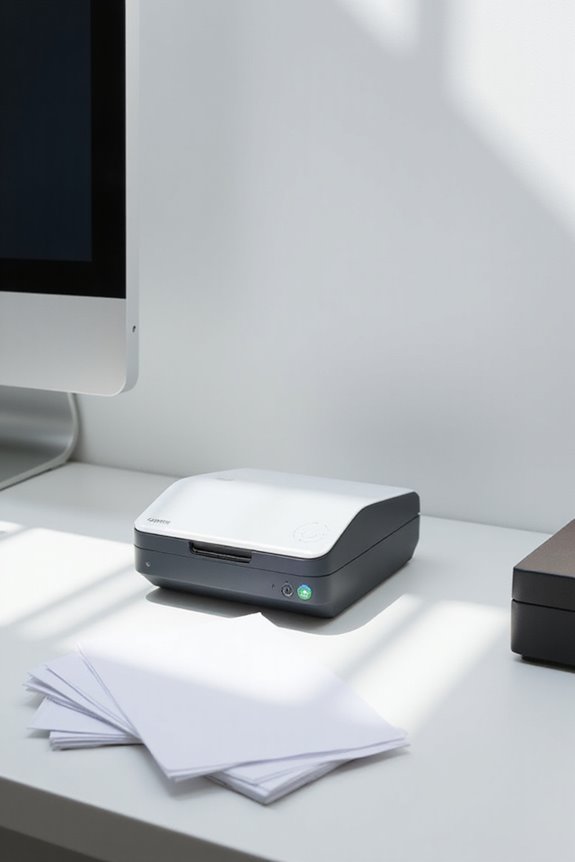
The easiest way to scan photos and documents. Supports 3x5, 4x6, 5x7, and 8x10 in sizes photo scanning but also letter and A4 size paper. Optical Resolution is up to 600 dpi ( PS: two setting: 300dpi/ 600dpi).

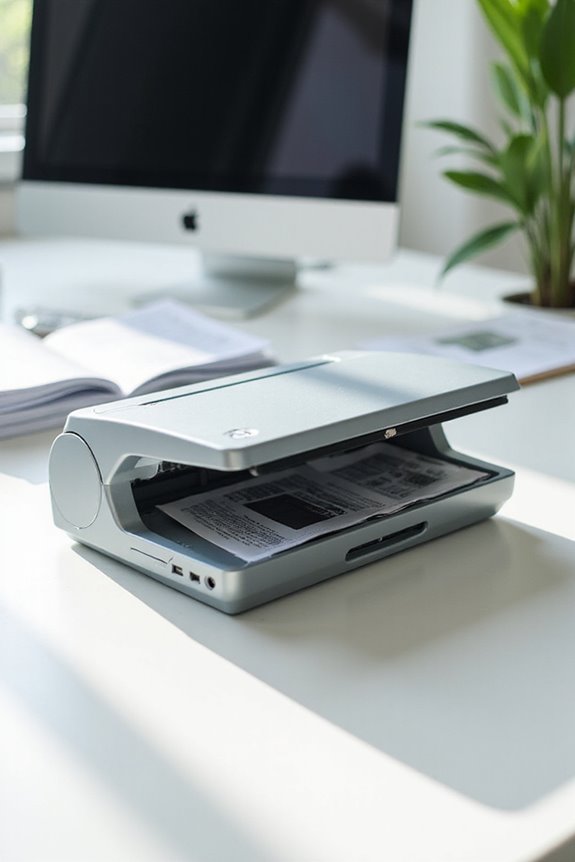
PORTABLE SCANNER FOR USE ON-THE-GO — The fastest and lightest mobile single-sheet-fed compact document scanner in its class¹
The Photodetection and Charge Generation Process
In the domain of CCD scanners, the process of photodetection and charge generation plays a pivotal role in image quality. When light strikes the CCD’s silicon photodiode, photon absorption initiates, liberating an electron and generating a corresponding hole. Each absorbed photon results in a proportional charge accumulation, directly impacting the image’s brightness. The liberated electrons, known as photoelectrons, migrate into the potential well, while holes move away, ensuring charge separation and integrity. This process allows us to gather and store charges in each pixel effectively. As we accumulate these electrons, we enhance the scanner’s sensitivity, especially in low-light conditions, ultimately empowering us to produce high-quality images with a broader dynamic range. Additionally, OCR technology enhances the usability of scanned images by converting them into editable text formats, further maximizing the potential of CCD scanners.
Exploring Charge Transfer and Readout Mechanisms
As we explore the mechanisms behind charge transfer and readout in CCD sensors, it becomes clear how essential these processes are for achieving high-quality imaging. Charge packets move through capacitors arranged in linear or two-dimensional arrays, where voltages applied to gate electrodes shift the charge smoothly, maintaining charge integrity. Maintaining transfer efficiency is crucial, as precise timing and voltage control prevent issues like charge trapping or leakage. Pixels are read out sequentially, with charges converted into analog voltage signals for digitization, creating uniform images. The readout register’s design guarantees orderly charge movement, minimizing signal variations. Overall, mastering these mechanisms allows us to capture detailed, clear images, reinforcing the importance of a well-executed charge transfer and readout process. Additionally, understanding OCR capabilities can enhance the functionality of scanners that utilize CCD technology for improved document management.
Advantages of Using CCD in Scanning Applications

CCD sensors bring a wealth of advantages to scanning applications, making them a top choice for professionals. One major benefit is their superior image quality, offering high spatial resolution that rivals or surpasses film. This guarantees precise detail in scans while enhancing grayscale accuracy. Low electronic noise from CCDs minimizes image artifacts, contributing to noise reduction, which is vital for high-precision tasks such as medical imaging or archival work. Additionally, their extraordinary light sensitivity allows for effective scanning even in low-light situations, securing reliable performance. With a broad dynamic range, CCDs accurately capture both light and dark areas, producing images with rich detail. These features collectively establish CCD technology as the preferred option for high-fidelity digital reproductions. Furthermore, scanners like the Epson Perfection V19 II utilize CCD sensors for high optical resolution, ensuring exceptional detail in photo enlargements.
Recommended Products

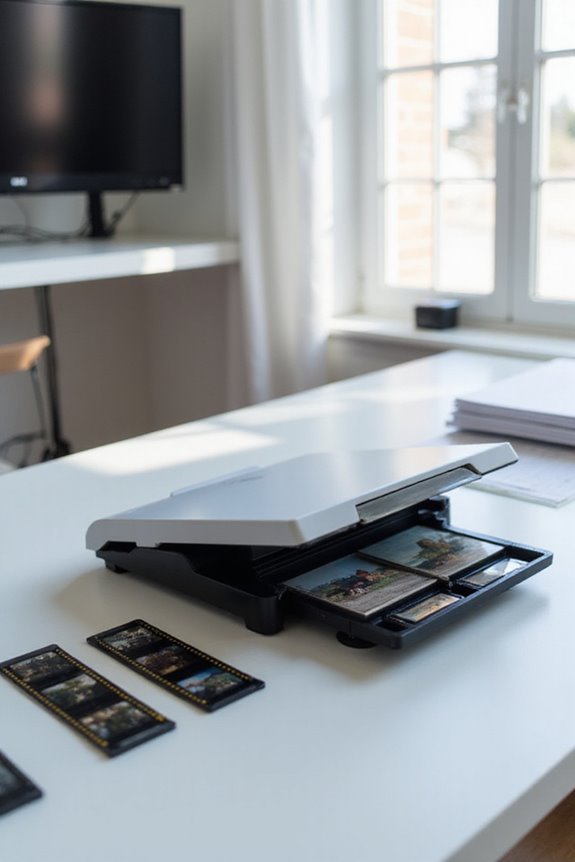
Create sharp, vivid reproductions 6400 dpi optical resolution1 for enlargements upto 17 x 22 inches

Enjoy high speed scanning in as fast as 8 seconds, with the included USB Type-C cable. With USB Type-C the Cano scan lied 400 has one cable for data and power.

Brand New in box. The product ships with all relevant accessories
Current Trends and Alternatives in Scanner Technology
With rapid advancements shaping the landscape of scanner technology, it’s clear we’re entering an exciting era of innovation. Emerging technologies like photon-counting CT and whole-body MRI are set to redefine diagnostic capabilities by 2026. Significantly, silent scan technology is projected to grow from $739.4 million in 2026 to $955.7 million by 2035, aligning with market trends focused on patient comfort and operational efficiency. As healthcare providers prioritize quieter imaging experiences, vendors are integrating AI to enhance scanning precision and speed. Moreover, advancements in 3D scanning allow for accuracy within 4-6 mm, expanding its use across various industries. These innovations not only improve diagnostic outcomes but also streamline workflows, making technology more accessible for healthcare professionals everywhere. The rise of 3D scanning precision enhances the detail and usability of models, crucial for fields such as design and engineering.
Recommended Products

PROFESSIONAL HIGH REFLECTIVITY: 3D Scanning Markers are Crafted with Professional-Grade Reflective Material and a Matte Surface, they Ensure Stable Tracking in Bright Workshops and on Dark Surfaces for Precise, Efficient 3D Modeling in Complex Scenarios. an Essential Calibration Tool for Optical Measurement, Mapping, and Machine Vision

【Accurate Size & Easy Peel】: Each dot features a 6mm inner and 10mm outer diameter, perfectly sized for detailed scanning tasks. Comes with 10 sheets (total 400 markers) of easy-peel, low-residue adhesive dots – fast to apply and clean to remove, ideal for frequent workflows or single-use projects.

Comprehensive Package: our Multi-Angle Marker 6 Sided Set includes a total of 6 Piece Multi-angle Markers along with 2 sheets/100 Point 3D Scanner 6mm Dots; This strategic combination promises the delivery of quality 3D scanning with enhanced precision and accuracy
Frequently Asked Questions
How Do I Maintain My CCD Scanner for Optimal Performance?
To maintain our CCD scanner’s ideal performance, we should implement effective cleaning techniques and regular calibration methods. By ensuring these practices, we can enhance its longevity and improve scanning quality consistently. Let’s stay proactive!
What Types of Documents Should I Avoid Scanning With CCD Scanners?
Scanning’s like walking a tightrope; we must avoid sensitive documents and textured materials that could tear or jam. Instead, let’s carefully select our materials, ensuring a smooth ride for our trusty CCD scanner!
Can CCD Scanners Handle Very High-Resolution Images?
Yes, CCD scanners handle very high-resolution images effectively, thanks to their high resolution capabilities and superior image quality considerations. We should always assess the specific needs to maximize their performance in different scanning applications.
What Software Is Best for Processing Images From CCD Scanners?
When considering software for processing images from CCD scanners, we should look for strong image editing capabilities and software compatibility. Options like MaxIm DL and CCDSoft are tailored to enhance our astrophotography experience effectively.
Are There Specific Lighting Conditions Ideal for Using CCD Scanners?
Isn’t it ironic that the best lighting for CCD scanners isn’t always the brightest? We’ve found using optimized lighting techniques in controlled environments notably improves their performance, leading to the most reliable scanning results we can achieve.